Soweto murder fugitive arrested following community tip-off and media campaign
A suspect wanted in connection with a murder in Soweto has been arrested after a successful media campaign. The breakthrough came when an alert member of the public provided a crucial tip-off to law enforcement.

In a significant development for community-led justice, a collaborative effort between the public and the media has successfully led to the arrest of a suspect wanted in connection with a murder case in Soweto. The apprehension of the fugitive, which was reported on 20 August 2026, highlights the growing effectiveness of public-private partnerships in tackling serious crime across South African townships. While violent crime remains a persistent challenge, this breakthrough demonstrates how rapidly information can circulate when the media and local communities work in tandem with law enforcement.
According to the initial reports, the breakthrough in the investigation came after a concerted media campaign, often referred to as a media blitz, was launched to locate the suspect. This campaign broadcasted information regarding the Soweto murder case, raising widespread awareness among citizens. Following the heightened publicity, an alert member of the community stepped forward with a critical tip-off. This crucial piece of information provided the breakthrough that police officers needed to track down and arrest the fugitive, ending his time on the run.
While the arrest has been confirmed, several key details regarding the case remain undisclosed. At this stage, official sources have not publicly released the identity of the arrested suspect, nor have they shared the name or age of the murder victim. The precise timeline of the murder, the specific neighbourhood within the sprawling township of Soweto where the crime occurred, and the exact circumstances surrounding the killing also remain unclear. Rather than speculating on these details, representatives and observers are waiting for formal statements from the South African Police Service (SAPS) to shed light on the specifics of the docket.
The success of this operation underscores the vital role that media campaigns play in modern South African policing. When law enforcement agencies or community safety initiatives leverage the reach of digital, print, and broadcast media, they effectively turn millions of citizens into active eyes and ears for the justice system. In high-density urban and residential areas like Soweto, a well-coordinated media blitz can make it incredibly difficult for fugitives to remain hidden, as their faces and alleged crimes are kept fresh in the public consciousness.
Furthermore, this arrest highlights the critical importance of community-oriented policing and whistleblowing in South Africa. For years, crime experts and community leaders have advocated for stronger trust between township residents and the police. A tip-off of this nature represents a tangible example of citizens taking ownership of their streets and refusing to allow violent criminals to find safe haven in their neighbourhoods. When residents trust that their information will be handled confidentially and acted upon swiftly, the barrier to reporting crime is significantly lowered.
Looking ahead, the focus now shifts to the South African judicial system. Following an arrest in a murder investigation, the standard legal procedure dictates that the suspect must appear in a local magistrate's court within 48 hours, excluding weekends and public holidays. During this initial appearance, the suspect is expected to face formal charges of murder, and the court will address preliminary matters such as legal representation and the scheduling of a bail hearing. Members of the Soweto community and the broader public will undoubtedly be watching closely to see how the prosecution builds its case based on the evidence gathered.
As the legal process begins to unfold, this case will likely serve as a benchmark for future mobilisations of media and community resources in unresolved criminal investigations. While the arrest marks a crucial first step toward securing justice for the victim and their family, the long road of trial proceedings lies ahead. The public remains urged to continue cooperating with law enforcement agencies, reinforcing the message that community vigilance remains one of the country's most powerful weapons against violent crime.
Reporting record
How this story was produced
This article was AI-generated from the frozen trend evidence and passed deterministic quality and safety gates. No cross-provider evidence review or independent human verification is claimed for this record.
- Byline
- Newstrends AI Newsroom
- First published
- Last material update
- No later material update recorded
- Distinct source identifiers
- 1 retained source identifier
Frozen source links for this publication
Chronology
Story timeline
A generated chronology for orientation; dates and details may require source verification.
Update
The arrest of the Soweto murder fugitive is reported following a successful media campaign and community tip-off.
Reader file
Frequently asked questions
01How was the Soweto murder suspect arrested?
The suspect was arrested after a widespread media campaign prompted a member of the community to provide a crucial tip-off to the police.
02Has the suspect in the Soweto murder been identified?
No, the identity of the suspect and the details of the victim have not yet been publicly released by official sources.
03What are the next steps in the legal process?
The suspect is expected to appear in a local magistrate's court, where they will face formal murder charges and address preliminary matters such as legal representation and bail.
Keep reading
Related coverage
More published reporting connected to this story.
Meyiwa Murder Mastermind Still at Large, Claims AfriForum
Civil rights organisation AfriForum has stated that evidence suggests the mastermind behind the murder of Senzo Meyiwa remains at large. This claim raises fresh questions about the completeness of the ongoing legal proceedings and the pursuit of full justice.

KZN Teen Sentenced to Life Imprisonment for Raping Disabled Woman
A teenager has been handed a life sentence in KwaZulu-Natal for the rape of a disabled woman. The ruling highlights the judiciary's strict stance on sexual violence against vulnerable citizens, though key case details remain protected.
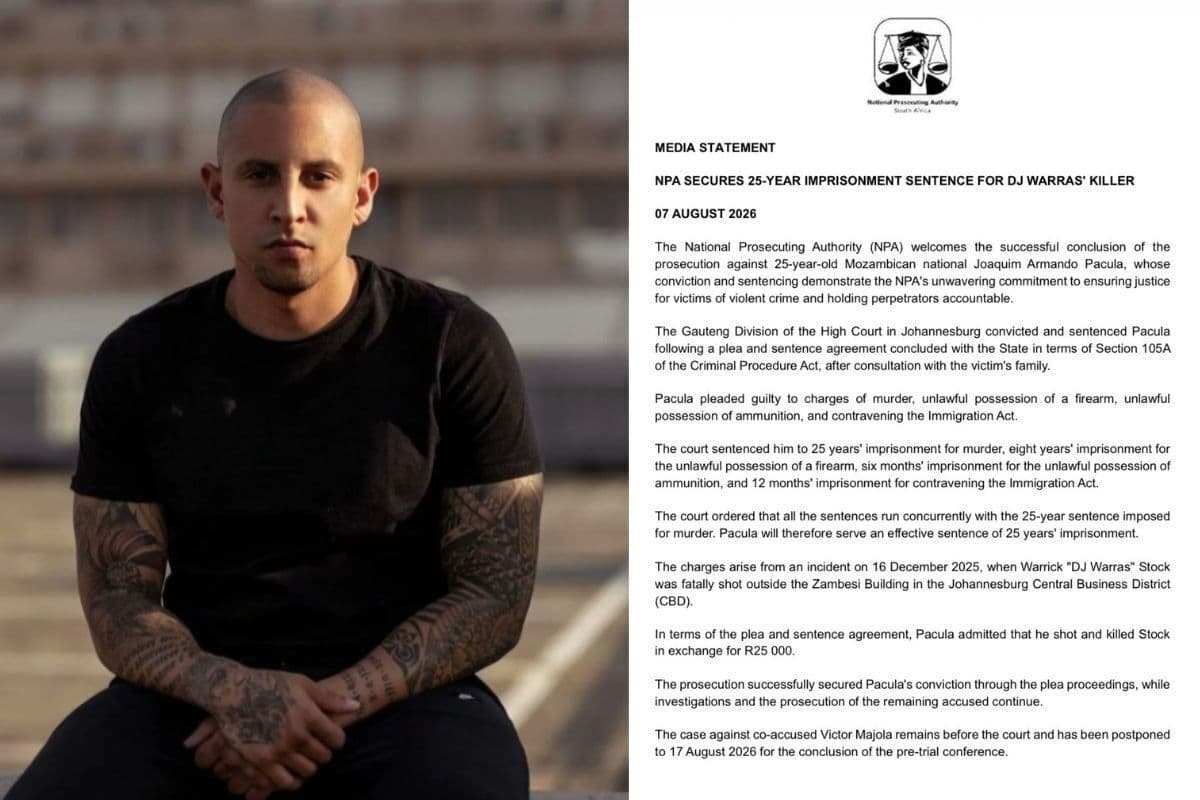
DJ Warras Murder: Convicted Killer Reveals Payment Details as Police Share How They Tracked Him Down
A convicted killer in the DJ Warras murder case has revealed the payment received for the hit. Police have also detailed the tracking methods used to apprehend the perpetrator, marking a major step in the high-profile investigation.

Stolen Porsche Recovered and Suspect Arrested in South African Vehicle Trafficking Crackdown
South African authorities have successfully recovered a stolen Porsche and arrested a suspect linked to an organized vehicle trafficking syndicate. While specific details of the operation remain limited, the recovery highlights the ongoing battle against high-value car theft in the region.
Brazen Armed Robbery Reported at Merebank Kali Amman Community Temple
Reports of an armed robbery at the Merebank Kali Amman community temple have sparked widespread concern across South Africa. While the incident has drawn significant public attention, official details regarding suspects, injuries, and stolen items remain unconfirmed.